


House of Zagonov
- This article may be unbalanced towards certain viewpoints. (January 2026)
- This article relies excessively on references to primary sources. (March 2023)
- Some of this article's listed sources may not be reliable. (January 2026)
| House of Zagonov Род Загоновых | |
 The House of Zagonov coat of arms
| |
| Polesian noble and ecclesiastical dynasty | |
| Country | Polesia |
|---|---|
| Etymology | Disputed; possibly from Proto-Slavic *zagonŭ ("enclosure", "fold")[1] |
| Founded | c. 1530s (traditional) c. −6th century (Vechnostist reckoning) |
| Founder | Vladimir Ivanovych Zagonov |
| Current head | Lev Ivanovych Zagonov ("The Elder") b. c. 1716; age 308 |
| Heir apparent | Andrei Ivanovych Zagonov b. c. 1984; age 40 |
| Seat | The Krepost, Polesia |
| Religion | Vechnostist Christianity |
| Hereditary condition | |
| Name | Zagonov syndrome (unofficial) |
| Characteristics | Accelerated phenotypic ageing; dramatically extended lifespan (est. 280–340 years)[2] |
| Known carriers | 5 confirmed (historical); 2 living[3] |
The House of Zagonov (Polesian: Род Загоновых, romanized: Rod Zagonovykh) is a dynastic family believed to rule from The Krepost, a fortress of undetermined location within the kingdom of Polesia, an Eastern European superpower. The family is defined by two interrelated phenomena: a hereditary genetic condition that simultaneously accelerates physical ageing and extends lifespan to an estimated 280–340 years;[2] and its founding role in Vechnostism (Вечностизм), a heterodox Christian movement that has become the dominant faith across Eastern Europe and a significant challenger to Roman Catholicism in the south of the continent.[4] No member of the family has been independently verified as alive by any state or scientific body.[10] Their existence is attested principally through Vechnostist ecclesial records and the activities of The Herd (Stado), a secretive inner circle that functions simultaneously as a chamber orchestra, a political council, and the family's sole public-facing apparatus.[10]
The current patriarch, Lev Ivanovych Zagonov, known publicly as The Elder (Starec), is believed to have been born c. 1716, making him approximately 308 years old. He has presided over the family's affairs from the ancestral fortress known as The Krepost for the majority of the last three centuries, during which time the Zagonov family has been credited with, or accused of, influencing major European political events, industrial development, and global religious trends.[6][7] His son and heir, Andrei Ivanovych Zagonov (b. c. 1984), also carries the hereditary condition.[3]
Public perception of the family is deeply polarised. Adherents of Vechnostism venerate the Zagonovs as living manifestations of divine will, while critics — including elements within the Polesian government under President Beltrov — characterise the family as a manipulative oligarchy exercising undue influence through religious coercion and covert political networks.[8][9]
The family's documented influence spans multiple domains. Historians have attributed to the Zagonovs a significant, if often covert, role in European affairs from the Thirty Years' War onward, including involvement in the Industrial Revolution, the shaping of colonial trade networks, and the manipulation of 20th-century political movements.[11][25] The family's administrative apparatus, known as the Elderhood (Starszyzna), evolved from a 16th-century ecclesiastical council into what analysts have described as a sophisticated transnational organisation with reported links to government institutions, multinational corporations, and intelligence agencies across multiple continents.[15]
The most persistent controversy surrounding the House of Zagonov concerns the deaths of over 300 women linked to The Elder's centuries-long attempts to produce an heir capable of carrying the hereditary condition.[18] The eventual birth of Andrei in 1984 to Lady Anastasia ended this pattern but did not resolve the political and ethical questions it had generated.[26] As of early 2026, Lady Anastasia is reported to be in severely declining health, prompting intensified speculation regarding The Krepost's internal affairs and the future of the dynasty. President Beltrov's administration has used the family's apparent fragility as an occasion to accelerate challenges to the church's remaining institutional authority.[8]
In recent years, Vechnostism has experienced a significant global resurgence, attracting followers disillusioned with both traditional organised religion and the perceived encroachment of artificial intelligence and algorithmic governance into daily life. The church's emphasis on human spiritual wisdom and its critique of technological dependence have found particular resonance in populations experiencing rapid digital transformation.[21] This expansion has coincided with growing internal tensions within the Zagonov household, as The Elder's declining physical capacity and Andrei's reported alcoholism have raised questions about the dynasty's long-term viability.[7][9]
- 1 Origins
- 2 Hereditary condition
- 3 Vechnostism
- 3.1 The Zagonov Schism
- 3.2 Decline and revival
- 3.3 Modern Vechnostism
- 4 History
- 5 The Krepost
- 6 The Herd
- 6.1 Structure and function
- 6.2 Known members
- 7 Notable family members
- 8 Political relationships
- 9 Controversies
- 10 Cultural depictions
- 10.1 Literature
- 10.2 Film and television
- 10.3 Visual art and music
- 10.4 Upcoming and announced works
- 11 See also
- 12 References
- 13 Further reading
- 14 External links
Origins edit
Vladimir Zagonov and the founding myth
The earliest documented references to the Zagonov lineage centre on Vladimir Ivanovych Zagonov, who is believed to have been born in the mid-16th century in what is now central Polesia. According to Vechnostist tradition, Vladimir's father was a mystic consumed by the pursuit of defeating death; his mother is said to have died during childbirth.[5] Academic consensus attributes the earliest reliable references to Vladimir to the 1570s, though Vechnostist hagiographic texts place his birth considerably earlier.[11]

Vladimir's rapid physical ageing — reportedly appearing elderly while still in his twenties — combined with apparent imperviousness to age-related mortality generated significant attention in a region already steeped in folk mysticism. Contemporary accounts are contradictory: some describe him as a figure of reverence, while others record attempts by local ecclesiastical authorities to have him tried for witchcraft.[13] The historian Marek Podolski has argued that Vladimir's condition was likely interpreted through the available cultural frameworks of the period, which offered only two explanatory categories: "divine miracle or diabolical corruption."[11]
Vladimir's efforts to produce offspring were attended by considerable tragedy. Vechnostist sources record that many of the women who bore his children died during or shortly after childbirth, and that relatively few children survived to carry the hereditary condition.[5] This pattern would recur throughout the family's history. Despite these losses, Vladimir succeeded in establishing a lineage, and his growing reputation attracted alliances with powerful European figures who were "enticed by his seemingly mystical longevity."[14]
The Elderhood
As his influence expanded, Vladimir founded a body known as The Elderhood (Starszyzna), a council that functioned as both a governing body for the nascent Vechnostist movement and a political instrument for advancing the family's interests. The Elderhood would evolve considerably over subsequent centuries, eventually becoming a sophisticated covert organisation with influence in global political, economic, and scientific institutions.[15] Under Lev Zagonov's stewardship in the 19th and 20th centuries, the Elderhood reportedly operated as a clandestine arm of the family, exerting influence across government, industry, and academia.[6]
Hereditary condition edit
The defining biological characteristic of the Zagonov lineage is a rare genetic condition that produces two paradoxical effects: dramatically accelerated phenotypic ageing, such that carriers may appear decades older than their chronological age, and an extreme extension of natural lifespan, with estimated longevity of 280 to 340 years.[2] The condition is believed to follow an autosomal dominant inheritance pattern, though penetrance appears to be incomplete; not all descendants have manifested the trait.[16]
No peer-reviewed study has been permitted by the family, and the precise genetic mechanism remains unknown. Dr. Lena Vargová of the Jagiellonian University Institute of Genetics has speculated that the condition may involve a novel mutation affecting telomere maintenance, producing what she described as "a catastrophic uncoupling of somatic ageing from organismal mortality."[2] Others, including Yegor Kravchuk of the Polesian Academy of Sciences, have questioned whether the longevity claims can be verified at all, noting that "the primary evidence for The Elder's supposed age rests on Vechnostist ecclesial records, which are not independently auditable."[17]
Carriers of the condition are reported to exhibit visible physical deterioration far in advance of their chronological age. Andrei Zagonov, aged 40, is reported to have the physical appearance of a man of approximately eighty.[3] The Elder himself has been described in rare eyewitness accounts as possessing a "wrinkled, thin, tapeworm-like frame," largely confined to darkness.[6]
The condition's impact on reproduction has been a consistent source of both tragedy and controversy. Throughout the family's history, women bearing children fathered by Zagonov males have suffered an extremely elevated mortality rate during or shortly after childbirth. Lev Zagonov's centuries-long attempt to produce an heir is reported to have resulted in the deaths of over 300 women before the successful birth of Andrei in 1984.[18] This aspect of the family's history has attracted sustained criticism from human rights organisations and has been a central point of contention in the ongoing political conflict between the family and the Polesian state.[9]
Physical appearance of living carriers
The physical effects of the condition on living carriers have been a subject of persistent speculation, complicated by the near-total absence of independently verified imagery of any Zagonov family member. What is known — or reported — derives principally from Vechnostist publications, accounts by former members of The Herd, and a small number of contested eyewitness descriptions.
Andrei Zagonov, aged 40, is consistently described as presenting the appearance of a man in his late seventies or eighties. Former associates have reported pronounced bloating of the skin, particularly of the face and hands, consistent with the oedemic deterioration documented in other progeroid conditions but occurring at an unusually slow rate relative to the overall acceleration of ageing.[3] He is reported to wear a crimson blazer — understood to be a simplified, secular adaptation of the Vechnostist liturgical vestment — and to maintain long, unkempt hair that former Herd members have described variously as "wild," "unwashed," and "a mane belonging to a man three times his age."[51] His physical bearing has been characterised as that of a much larger and heavier man than his frame would suggest, a quality attributed by Vargová to the fluid retention and tissue distortion typical of the condition's middle stages.[2] Based on extrapolation from The Elder's own trajectory and the limited longitudinal data available from earlier carriers, Vargová has estimated that Andrei's lifespan may extend to approximately 350 years — somewhat longer than his father's projected range — though she has cautioned that such estimates are "necessarily speculative, given a sample size that would embarrass any statistician."[16]
Far less is known about the physical appearance of Lev Zagonov ("The Elder"). Paradoxically, the limited accounts that exist suggest a figure who appears markedly healthier than his son, despite being approximately 268 years his senior. A former aide, speaking anonymously to Polesian Weekly in 2019, described The Elder as "shrunken, yes — impossibly thin — but not decomposing. Not what you would expect. The skin is tight. The eyes are clear. He looks like something preserved, not something dying."[6] This apparent stabilisation in the condition's later stages has been cited by Vargová as evidence that the Zagonov mutation may involve a "plateau phase" in which phenotypic deterioration decelerates or arrests entirely after several centuries, though she has acknowledged that this hypothesis rests on a single unverifiable case.[16]
The Elder is reported to spend the overwhelming majority of his time seated on a suspended crimson swing within his private sanctum, a detail that has been corroborated by multiple independent sources over several decades.[6][24] Medical analysts consulted by the Polesian Tribune have speculated that the swing serves a therapeutic function: the gentle, continuous motion may alleviate the joint calcification and circulatory stasis associated with extreme age, while the suspended posture distributes body weight in a manner that reduces pressure on a skeletal system reported to be extraordinarily brittle. The former aide described the arrangement in more blunt terms: "He cannot lie flat. His bones will not tolerate it. He cannot stand for longer than a few seconds. The swing is not ceremonial. It is the only position in which his body still functions."[71]
Vechnostism edit

The Zagonov Schism
Vladimir Zagonov's most enduring legacy is the religious movement he initiated, originally termed the Zagonov Schism and now known as Vechnostism (from Polesian вечность, "eternity"). Initially condemned as heretical by established Christian authorities, Vladimir leveraged the upheavals of the Protestant Reformation to position his doctrine as a legitimate reformist branch of Christianity. The faith integrates traditional Christian teachings with esoteric practices centred on longevity, the sanctity of the Zagonov bloodline, and a quasi-scientific approach to life extension.[4]
The foundational theological claim of Vechnostism is that the Zagonov hereditary condition is not a biological anomaly but a divine inscription — a mark placed upon the family by God as living proof that the boundary between mortal and eternal can be crossed in the flesh. The condition's dual nature — the simultaneous acceleration of ageing and extension of lifespan — is interpreted within Vechnostist doctrine as a recapitulation of the Passion: the carrier suffers visibly, bearing the disfigurement of centuries compressed into decades, in order that they may endure beyond natural death. The central Vechnostist text, the Wieczna Kronika ("Eternal Chronicle"), compiled under Vladimir's direction in the late 16th century, states that "the blood of the family is the blood of the covenant renewed — not spilled upon the cross but carried in the vessel, a chronicle written by God upon the living body."[78]
This doctrine — sometimes called the Doctrine of the Living Chronicle — positions the Zagonov bloodline not merely as sacred but as scripturally generative: the family's biological existence is itself treated as a form of ongoing divine revelation, equivalent in authority to the written Gospels. Adherents are taught that to witness the suffering of a carrier is to participate in a sacrament. The Rite of Witness (Obrzęd Świadectwa), one of Vechnostism's seven central observances, requires the faithful to sit in prolonged silence before an image or relic associated with a carrier's body — a lock of hair, a vial of blood, a casting of a hand — and to meditate upon the "scripture of the flesh."[78] The theological scholar Siobhán Brennan has noted that this practice has no precedent in any branch of Christianity and more closely resembles the relic veneration traditions of medieval Catholicism "pushed to a logical extreme that the medieval church itself would have found deeply uncomfortable."[4]
The Wieczna Kronika also codifies what later critics would identify as the faith's most controversial structural principle: the Hierarchy of Revelation. This doctrine holds that the family's living testimony takes precedence over all prior scripture. Where the Gospels and the family's pronouncements conflict, the family's word governs, on the grounds that a living revelation supersedes a recorded one. In practice, this means that The Elder — as the oldest living carrier — functions not merely as the head of the church but as its supreme theological authority, capable of overriding any doctrinal position, any historical teaching, and any scriptural interpretation by the simple act of speaking.[79] Critics have argued that this renders Vechnostism structurally indistinguishable from a personality cult. The theologian Paweł Rutkowski of the Kraków Pontifical Academy has described the Hierarchy of Revelation as "the single most elegant mechanism for the concentration of absolute power ever devised within a nominally Christian framework — it makes the patriarch not merely infallible but definitionally so, since the criteria for truth are whatever he says they are."[79]
A persistent line of criticism, advanced most forcefully by Brennan, holds that the Christian elements of Vechnostism are essentially decorative — a scaffolding of familiar liturgical language erected around what is, in substance, a dynastic ancestor cult. Brennan has argued that "the figure of Christ appears in Vechnostist theology as a prologue rather than a protagonist — a precursor whose function was to prepare the ground for the true revelation, which is the Zagonov bloodline itself. The Resurrection is acknowledged; it is simply treated as incomplete. Christ rose from the dead, but he died again. The Zagonovs do not die. That, for the Vechnostist, is the point."[4] The Vechnostist church has rejected this characterisation, maintaining that the family's condition is "the fulfilment of the Resurrection promise, not its replacement."[56]
The faith's relationship with its critics has historically been characterised by systematic and often ruthless suppression. The Wieczna Kronika contains a passage, known colloquially as the Clause of Silence (Klauzula Ciszy), which designates public denial of the family's divine nature as "a sin against the living covenant" punishable by permanent exclusion from the community of the faithful.[78] In practice, enforcement has historically extended well beyond spiritual sanction. The Elderhood maintained, from at least the 17th century until the modern era, a network of agents tasked with the identification and neutralisation of vocal critics — a function that church sources have euphemistically described as "the ministry of quietude."[80] The journalist Demenkov, investigating this network in 2019, documented the disappearances of at least eleven prominent anti-Vechnostist campaigners across Eastern Europe between 1955 and 2003, noting that "in each case, the individual in question had recently published or was preparing to publish material critical of the family. In each case, the Polesian authorities recorded the disappearance and took no further action."[80]
The early growth of Vechnostism was supported by an ambitious programme of ecclesiastical construction. The family commissioned a series of cathedrals, estates, and temples, many deliberately built upon the ruins of older religious sites — a practice that attracted both awe and considerable controversy.[19] These structures became focal points for the new faith and, in some regions, objects of folklore and superstition in their own right.
Decline and revival
Vechnostism suffered a significant decline following the assassinations of Vladimir and Katerina Zagonova in the 18th century, and was further weakened by the intellectual challenges posed by the Enlightenment, which promoted secular empiricism over the mystical-scientific synthesis favoured by the Zagonov doctrine.[20] By the mid-18th century, the movement had fragmented into a number of smaller sects, and the family found itself in a state of intellectual and political isolation.
The faith's fortunes reversed dramatically in the 19th century under the stewardship of Lev Zagonov, who revived it as both a religious and socio-political force. Lev repositioned Vechnostism as compatible with industrialism and emerging democratic movements, and employed the growing church as a vehicle for expanding the family's economic and political influence.[6]
Modern Vechnostism
In the contemporary period, Vechnostism is the dominant religious movement across much of Eastern Europe and has established significant footholds globally, particularly in regions characterised by disillusionment with both traditional religion and secular technological modernity. The church's emphasis on human insight, spiritual wisdom, and the "mystical aspects of existence" has been identified by sociologists as resonating strongly with populations sceptical of artificial intelligence and algorithmic governance.[21]
Vechnostist adherents are distinguished by a crimson horizontal stripe painted across the eyes, applied during all liturgical and official functions. The faith's rituals blend musical performance with religious ceremony; the ancestral compositions performed by The Herd serve as the primary vehicle for evangelisation.[10]
History edit
Expansion and the Thirty Years' War
During the 17th century (−5th century in Vechnostist reckoning), the family's influence expanded considerably. New members of the lineage, including Dmitri Zagonov, a reportedly charismatic leader who extended the family's reach into the Baltic regions, and Katerina Zagonova, who became a revered figure within the Elderhood, played significant roles in consolidating the dynasty's position.[14] The family invested heavily in alchemical and early chemical research, seeking to mitigate the reproductive fatality associated with their condition.
The Zagonov family's involvement in the Thirty Years' War (1618–1648) is a subject of considerable historical debate. Vechnostist sources claim the family provided strategic support to certain factions in pursuit of favourable religious concessions, while secular historians have characterised their role as opportunistic profiteering.[22] During this period, the family also established secretive colonial ventures and trade routes in the Americas and Asia, creating what Podolski has described as a "shadow empire" operating in parallel with the established Western colonial powers.[11]
Assassination of Vladimir and Katerina
On the night of 14 September 1741, Vladimir and Katerina Zagonov were killed during a coordinated attack on the Vechnostist conclave then assembled at the Basilica of the Eternal Witness in Kraków, at that time the principal seat of Vechnostist authority outside The Krepost itself.[20] The attack, which occurred during a liturgical convocation attended by senior members of the Elderhood, was carried out by a group of approximately thirty armed men who breached the basilica's eastern cloister shortly after midnight. Vechnostist accounts describe the assailants as wearing the uniforms of the Polesian civic guard, though no official military or governmental body has ever claimed responsibility.
Vladimir, then in his third century of life, was reportedly stabbed repeatedly in the nave of the basilica. Katerina was killed in a connecting vestry, where she had been meeting with members of the Elderhood's inner council. Contemporary Vechnostist chronicles describe the scene in graphic and liturgical terms — the blood pooling on the altar steps, the scattered pages of the Canticles, the silence that followed — though the degree to which these accounts are historical or hagiographic remains contested.[72] Several members of the Elderhood were also killed or wounded in the attack, and a substantial quantity of ecclesial records and musical manuscripts were destroyed in a fire that consumed the basilica's eastern wing in the hours that followed.
Responsibility has been variously attributed to agents of the Catholic Church, which viewed Vechnostism as an existential threat to its authority in Southern and Central Europe; to rival factions within the broader Protestant movement, who regarded the Zagonovs' claims of divine longevity as blasphemous; and to internal dissidents within the Vechnostist hierarchy itself, who opposed Vladimir's increasingly autocratic governance of the church.[20] The historian Marek Borowski has argued that the most likely explanation is a coalition: "No single faction possessed both the motive and the operational access. The basilica's defences were formidable. This was a betrayal from within, facilitated by enemies without."[72]
The deaths precipitated a severe crisis within Vechnostism, leading to significant fragmentation and a loss of followers across Europe. Leadership of the remnant movement passed to Dmitri Zagonov, Vladimir's son, who managed the church through a prolonged period of decline but lacked his parents' charisma and strategic acumen. The basilica itself was never rebuilt; its ruins were demolished in the 19th century, and the site is now occupied by a municipal car park, a detail that Demenkov has described as "the most Polesian footnote in the history of European religion."[24]
Birth of Lev Zagonov
Lev Ivanovych Zagonov, later known as The Elder, was born during this period of turmoil, c. 1716. His birth was characterised within the Vechnostist tradition as a sign of renewal and resilience.[6] Lev grew up in a rapidly changing world in which the family's influence was waning and the Enlightenment was posing fundamental challenges to the blend of mysticism and empiricism that underpinned Vechnostist thought. The death of his father, Dmitri, during the early 20th-century upheavals in Polesia, left Lev as the sole senior member of the bloodline.[23]
19th-century resurgence
Under Lev's leadership, the family underwent a dramatic transformation. Described by the journalist Ilya Demenkov as "a master of perception,"[24] Lev revived the Zagonov Schism as a modern socio-political force, strategically aligning it with the values of industrialism and democratic reform. The church, under his control, became deeply involved in the Industrial Revolution, secretly funding and controlling key industries while cultivating a network of political loyalists within emerging democratic institutions.[6]
During this period, the family increasingly retreated from public life, operating from behind a façade of religious and philanthropic activity while the Elderhood acted as a covert instrument of influence across political, industrial, and scientific domains. Lev's personal life was marked by an increasingly desperate and unsuccessful campaign to produce an heir, a process attended by significant loss of life.[18]
20th-century influence
The family's involvement in 20th-century events is a matter of intense scholarly and popular debate. Vechnostist and sympathetic sources credit the family with neutralising much of the Polesian Revolution, preventing the full emergence of communism in Polesia and steering the nation towards a unique hybrid political system.[23] Critics characterise these interventions as self-serving authoritarianism.
During the Cold War, the family is alleged to have intensified its espionage activities, functioning as "a third, hidden player" in the global power struggle.[25] Their influence is alleged to have extended to the manipulation of decolonisation processes, the establishment of puppet regimes, and the covert funding of artistic and scientific movements that aligned with the family's agenda.[15]
By the late 20th century, the family had reportedly established a clandestine digital surveillance network infiltrating government and corporate systems worldwide. The collapse of the hybrid Polesian state in the early 1990s was, according to the investigative reporter Nataliya Shcherbak, "orchestrated and expedited by the church" to exploit the resulting power vacuum.[26]
Birth of Andrei Zagonov
In 1984, after what Vechnostist sources describe as centuries of failed attempts, Lev Zagonov's son Andrei Ivanovych Zagonov was born to Lady Anastasia (Anastasia Romanova Zagonova). The birth was overshadowed by the cumulative toll of Lev's pursuit of an heir, which is estimated to have resulted in the deaths of over 300 women across several centuries.[18] Andrei has been raised within The Krepost with an awareness of his heritage and the responsibilities it entails. He carries the family's hereditary condition and, at 40 years of age, reportedly presents the physical appearance of a man in his eighties.[3]
The Krepost edit
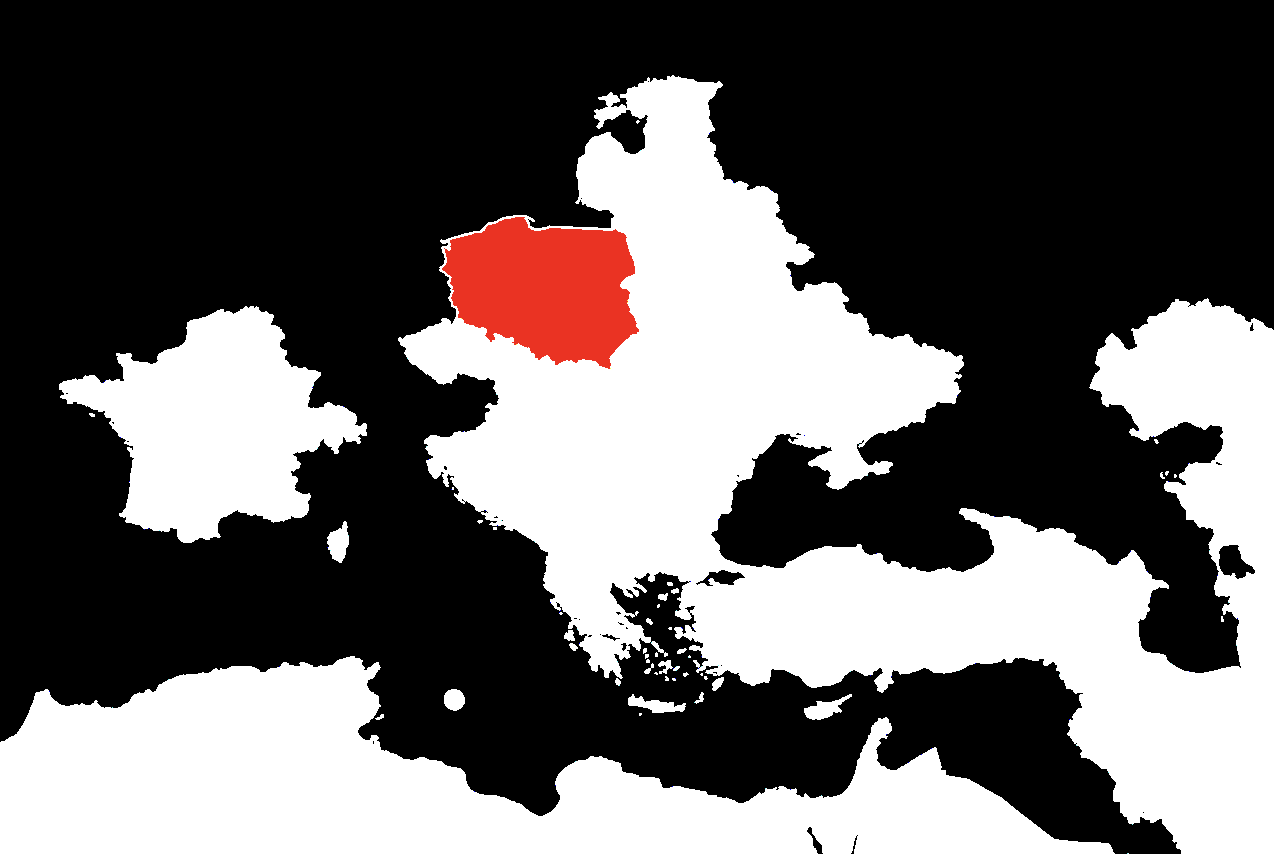
The Krepost (Polesian: Крепость, lit. "fortress") is the purported ancestral seat of the Zagonov family. The compound has never been opened to independent architectural survey, and its precise location remains a subject of significant academic and popular debate. Descriptions from the small number of individuals who claim to have visited the site characterise it as a vast, labyrinthine complex of stone corridors, liturgical chambers, libraries, and residential quarters, permeated by an atmosphere of incense, damp stone, and what one diplomatic envoy described as "a faint but persistent smell of formaldehyde."[28]
The Krepost is understood to house the Grand Cathedral used for Vechnostist liturgical performances, The Elder's private sanctum (to which access is strictly controlled by his aide Grigori), and facilities for the members of The Herd. The compound is staffed by individuals referred to in internal Vechnostist terminology as "Krepost slaves," though the church has publicly disputed this translation, insisting the correct rendering is "servants of the eternal."[29]
Location theories
The location of The Krepost has been contested for over a century, with no definitive evidence placing the structure at any confirmed coordinates. Competing theories have proliferated in both academic literature and popular speculation, broadly falling into three categories.[42]
The most conventional hypothesis, advanced by the historian Marek Podolski and others, holds that The Krepost is a surface-level or partially subterranean compound situated in the remote forested interior of central Polesia, possibly in the Białowieża region or the Pripyat marshlands. Proponents cite the logistical requirements of the Vechnostist apparatus — including the transport of musical instruments, construction materials, and personnel — as evidence that the structure must be accessible by conventional means.[11]
A second theory, which gained prominence following a 2019 Der Spiegel investigation, posits that The Krepost is an entirely underground complex, possibly a repurposed Cold War-era military installation or a purpose-built subterranean fortress. This theory draws on testimony from a former Polesian intelligence operative who described being transported to the site via "a descent lasting several hours" and recalled "no natural light at any point during a three-day visit."[7] The underground hypothesis is supported by the notable absence of The Krepost from any known satellite imagery, despite decades of surveillance by multiple state agencies.[43]
A third and more controversial theory concerns the so-called hadal hypothesis, which proposes that The Krepost is located within a hadal trench — an oceanic environment at depths exceeding 6,000 metres. The hypothesis, first articulated in a 2021 paper by the marine biologist Dr. Yuliya Petrenko of the University of Bergen, draws on several strands of circumstantial evidence.[44] Adherents cite the reported depigmentation of the Zagonov family's skin, which in rare eyewitness accounts has been described as pallid, translucent, or entirely lacking in melanin — characteristics consistent with organisms adapted to environments devoid of sunlight. Petrenko further proposed that the hereditary condition itself may exhibit structural parallels with chemosynthetic metabolic processes observed in hadal fauna, in which energy is derived not from solar radiation but from chemical reactions, potentially offering a biological framework for the family's anomalous longevity.[44][45]
The hadal hypothesis has attracted both fascination and considerable scepticism. Critics, including Podolski, have dismissed it as "an imaginative exercise in pattern-matching" that conflates metaphorical and biological categories, noting that no evidence exists for human habitation at hadal depths and that the engineering required to maintain such a structure would be without precedent.[46] Petrenko has countered that the absence of evidence is itself consistent with a location designed to be undetectable, and has pointed to a series of since-suppressed photographs (see § Legal disputes) as partial corroboration.[44]
Legal disputes
The Vechnostist church has pursued an aggressive and sustained legal strategy to suppress the publication of information relating to The Krepost, its location, internal operations, and personnel. Since the early 2000s, the Elderhood's legal apparatus — operating through a network of Polesian and international law firms — has initiated proceedings against journalists, media organisations, non-governmental organisations, and individual researchers who have published or attempted to publish material deemed by the church to constitute disclosure of confidential ecclesial information.[67]
The most prominent case involved the Polesian investigative outlet Novaya Polesia, which in 2022 published a series of photographs purporting to depict the interior and exterior environs of The Krepost, attributed to an anonymous former member of The Herd. The images — which included exterior views showing skies of a colour and luminosity inconsistent with any known atmospheric conditions in Polesia — were removed from the publication's website within 72 hours following an emergency injunction obtained by Vechnostist legal representatives in a Polesian commercial court. The newspaper was subsequently ordered to pay damages reported to exceed €2.4 million, and its editor-in-chief received what press freedom organisations described as a "chilling" personal liability ruling.[47][68] The photographs have not been republished by any mainstream outlet, though they are understood to circulate in redacted form on encrypted file-sharing platforms.
The Vechnostist legal strategy has extended beyond Polesian jurisdiction. In 2023, the London-based human rights organisation Polesia Watch published a report documenting alleged labour abuses within The Krepost, based on testimony from individuals claiming to be former "Krepost slaves." The Elderhood filed suit in the High Court of England and Wales under breach of confidence, arguing that the testimony constituted disclosure of information obtained under conditions of ecclesial privilege. The case was settled out of court, with Polesia Watch agreeing to withdraw the report and issue a statement acknowledging that its sources "could not be independently verified."[69] Amnesty International subsequently described the settlement as "a template for the suppression of legitimate human rights reporting through the instrumentalisation of commercial litigation."[9]
In total, the Reporters Without Borders 2025 annual report identified at least fourteen separate legal actions initiated by Vechnostist-affiliated entities against journalists or civil society organisations in the preceding five years, spanning jurisdictions including Polesia, the United Kingdom, France, Germany, and the United States. The report characterised the pattern as "a systematic deployment of litigation as censorship," noting that the financial burden of defending such actions was sufficient to deter investigation regardless of the merits of the underlying claims.[70]
State relationship
The Polesian state's relationship with The Krepost has oscillated between tacit accommodation and active confrontation. For much of the 20th century, successive governments — many of which contained Elderhood-affiliated officials — effectively treated The Krepost as an extraterritorial enclave, declining to assert jurisdictional authority over the site or its inhabitants.[24]
Under President Beltrov, this posture has shifted markedly. The Beltrov administration has publicly demanded independent inspection of The Krepost on multiple occasions, citing concerns related to labour practices, building safety, and the welfare of individuals residing within the compound.[8] These demands have been rejected by the Vechnostist church, which maintains that The Krepost constitutes sacred ground exempt from secular jurisdiction. In 2025, the Polesian parliament passed the Ecclesiastical Transparency Act, which in principle grants state inspectors access to religious properties exceeding a specified size; the legislation is widely understood to have been drafted with The Krepost specifically in mind, though enforcement remains a practical impossibility given that the state has not confirmed the structure's location.[49]
Intelligence sources have indicated that Polesian state security services maintain an active file on The Krepost, designated internally as Object Zamok ("Castle Object"), and that efforts to determine its location through aerial surveillance, signals intelligence, and infiltration of the Vechnostist hierarchy have been ongoing since at least the early 2000s.[43] A leaked briefing document from 2024 described these efforts as having produced "no actionable geographic intelligence" despite over two decades of investment.[35]
The Herd edit
Structure and function
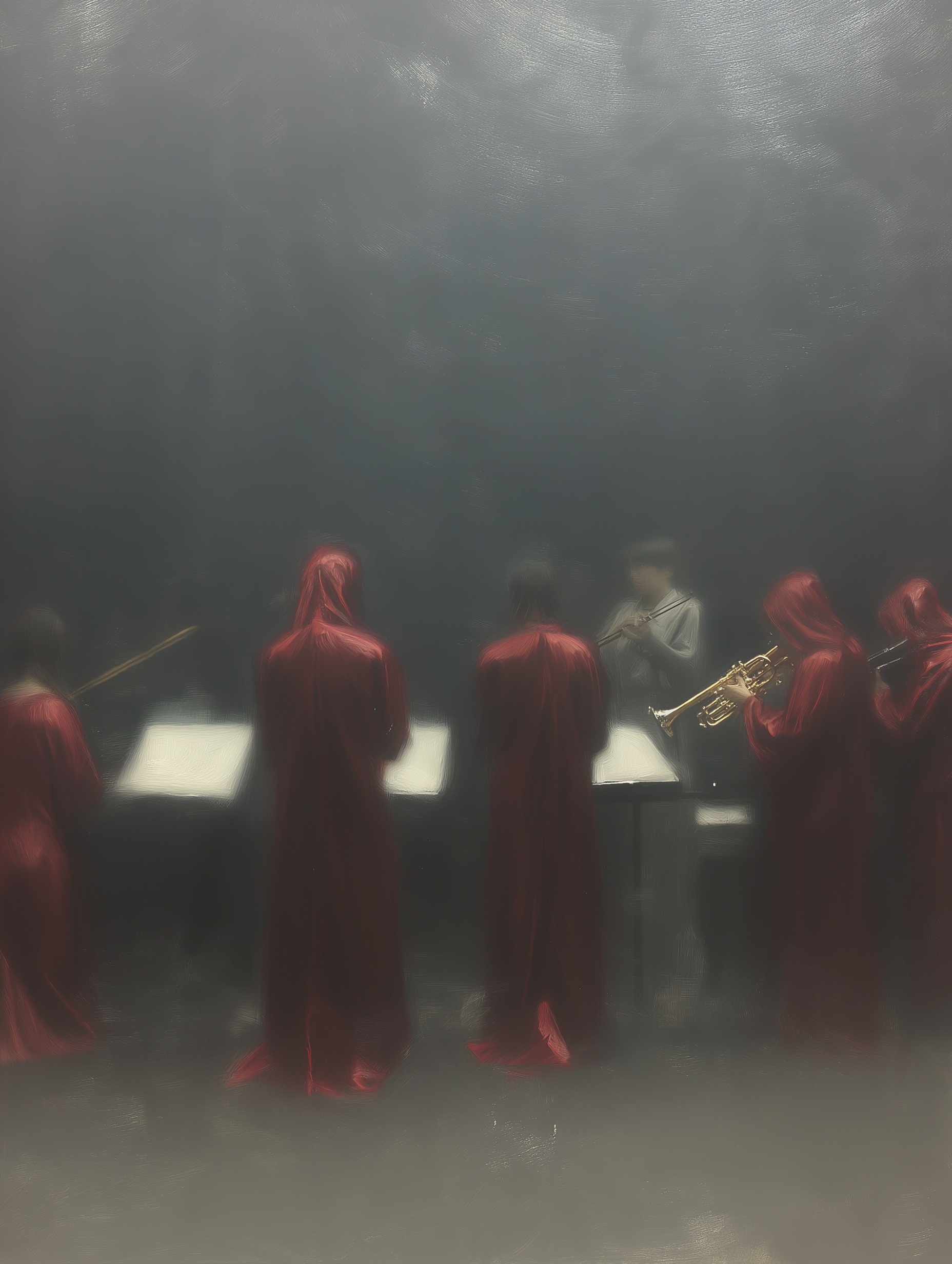
The Herd (Stado) is a small, prestigious group of devoted followers who serve as the innermost operational circle of the Zagonov family's Vechnostist enterprise. Members are distinguished by a crimson horizontal stripe painted across the eyes and perform a range of functions that blur the boundaries between liturgical performance, political counsel, intelligence gathering, and personal service to the family.[10] The group serves as the performing ensemble for the ancestral compositions used in Vechnostist evangelisation, which are broadcast to millions of adherents worldwide.
Crucially, given the total seclusion of the Zagonov family, The Herd functions as the sole public-facing apparatus of the entire Vechnostist enterprise. Members serve as official spokespersons, press liaisons, and diplomatic intermediaries for both the church and the family — roles that, in any conventional institution, would be occupied by a dedicated communications or governmental affairs division. The Herd's leader conducts all press conferences, issues all public statements, and represents the church in negotiations with the Polesian state and foreign governments.[30] Individual members have been observed attending parliamentary hearings, meeting with foreign ambassadors, and appearing at cultural events in an official capacity. The journalist Wójcik has described The Herd as "simultaneously a chamber orchestra, a press office, a diplomatic corps, and a praetorian guard — an arrangement that would be absurd if it were not so effective."[54]
The group's public performances, though officially liturgical in nature, have become major cultural events in their own right. Vechnostist "sacred concerts" — large-scale performances of the ancestral compositions staged in secular venues — have repeatedly sold out some of the largest arenas and concert halls in Eastern and Central Europe, with reported engagements at venues exceeding 10,000 capacity in Polesia, the Czech territories, and the Low Countries.[74] Ticket revenue from these events, combined with substantial Vechnostist "tithes of witness" levied on attendees, has been identified by Demenkov as a significant and largely unregulated revenue stream for the church (see § Financial resources and undisclosed capabilities).[66] The performances attract both devoted adherents and a growing audience of secular listeners drawn to the music's unusual sonic character, a crossover phenomenon that the church has alternately encouraged and denounced depending on the prevailing internal politics.[74]
The Herd operates under a hierarchical structure, with a designated leader who answers directly to The Elder and his heir. Internal dynamics within the group have been described by former associates as intensely competitive and psychologically fraught, characterised by what the sociologist Ewa Jankowska termed "a closed ecosystem of mutual dependency and mutual destruction."[30]
Known members
The current composition of The Herd, as reported by the Polesian press and corroborated by Vechnostist publications, includes:
| Name | Origin | Role | Notes |
|---|---|---|---|
| Everard | Western Europe (affluent background) | Conductor, spokesman, leader | Described as fanatically devoted to the Vechnostist cause. Known for volatile temperament and compulsive leadership style.[31] |
| Ksenia | Minsk, Polesia | Virtuoso string musician | Recruited from poverty after estrangement from family. Believed to have joined The Krepost c. late 2025.[32] |
| Anika | Poland (suburban) | Synth, observation | Described as possessing an unusually perceptive or "prophetic" capacity. Contested: attributed to divine gift by Vechnostist sources; attributed to cold reading by sceptics.[33] |
| Pedro | Lisbon, Portugal | Brass, public relations | Entered The Krepost from an economically disadvantaged background. Noted for self-promotional instincts and reported ambitions to modernise the church's public image.[34] |
| Ivan | Siberia, Polesia | Enforcer, security | Described as taciturn and physically imposing. Serves primarily in a security and logistical capacity.[35] |
Music and the ancestral compositions
The musical output of The Herd constitutes the primary cultural product of the Vechnostist enterprise, and for many observers it represents the only tangible, analysable material produced by the Zagonov apparatus in the modern era. The compositions performed by The Herd are attributed to The Elder himself, reportedly dictated or transcribed through intermediaries over a period spanning centuries. The church refers to these works collectively as the Canticles of Eternity (Pieśni Wieczności), and treats them as sacred texts equal in doctrinal authority to the written scriptures of Vechnostism.[57]

Musicological analysis of the compositions that have been recorded or broadcast publicly has identified a distinctive and highly unusual sonic language. Dr. Hanna Lisowska of the Warsaw Conservatory has described the works as "occupying a space between liturgical plainchant, late Romantic orchestration, and something that resists categorisation entirely — passages of sustained microtonality and deliberate harmonic friction that appear to serve no conventional musical function."[58] The compositions are scored for an ensemble of strings, brass, voice, and what Vechnostist sources describe as "ancestral instruments" — devices of unclear provenance that produce timbres not associated with any known instrument family. Efforts to identify these instruments from audio recordings have been inconclusive.[59]
Alongside these acoustic elements, the compositions make extensive use of electronic synthesisers and what analysts have characterised as industrial sonic textures — metallic drones, processed mechanical noise, and sustained low-frequency oscillations that appear to be generated electronically rather than acoustically. The presence of synthesised sound in Vechnostist sacred music has been a source of considerable interest, in part because of the Zagonov family's documented historical involvement in the development of electronic instruments themselves.[65]
Financial records uncovered by the investigative journalist Demenkov in 2017 revealed that the Elderhood provided substantial early funding to several pioneering figures in electronic music and instrument design during the early-to-mid 20th century. The Zagonov apparatus is reported to have been among the principal backers of research into vacuum tube oscillator circuits and early voltage-controlled synthesiser prototypes, channelling resources through a network of Vechnostist-affiliated foundations and academic grants. Demenkov described the scale of investment as "disproportionate to any plausible liturgical need," suggesting that the family viewed emerging audio technology as a strategic asset as much as a devotional tool.[66] The family's patronage extended to recording technology more broadly; Elderhood-linked entities have been connected to early investments in magnetic tape recording, multitrack studio infrastructure, and — in the latter half of the century — digital audio processing systems.[65] The precise motivations for this sustained investment remain debated, though Lisowska has speculated that The Elder's compositions may have been "written for instruments that did not yet exist — and that the family simply funded their invention."[58]
A notable characteristic of the compositions is the presence of passages widely described as "unplayable" — sections requiring tempi, intervallic leaps, or sustained tones that are considered to exceed the physical limitations of conventional performance. Whether these passages are intended as aspirational, symbolic, or simply the product of a composer indifferent to performer welfare has been a subject of considerable debate. The Herd is understood to rehearse these works extensively, with former associates describing rehearsal schedules of up to sixteen hours per day during periods of liturgical preparation.[30] Reports of performance-related injuries, including repetitive strain, hearing damage, and what one unnamed former member described as "a kind of acoustic trauma that doesn't heal," have circulated in the Polesian press.[60]
The theological status of the music within Vechnostism is absolute. The compositions are not regarded as artistic expression but as direct emanations of The Elder's spiritual authority; to alter, "correct," or reinterpret a score is considered an act of doctrinal violation. This has created persistent tension within The Herd between members who advocate for pragmatic adaptation and those, reportedly led by Everard, who insist on literal fidelity regardless of physical cost.[31]
Notable performances and broadcasts
Vechnostist liturgical performances by The Herd are broadcast to adherents worldwide via a network of radio transmissions, satellite feeds, and — more recently — encrypted digital streams. The church does not permit recordings to be made by external parties, and the unauthorised distribution of Herd performances is treated as a serious doctrinal offence. Nonetheless, a number of recordings have entered public circulation through leaks, defections, and covert recording by journalists and intelligence operatives.[61]
The most widely circulated of these is a 1997 recording known colloquially as the "Gdańsk Tape," a 22-minute fragment of a performance believed to have been captured by a Polish intelligence operative at a Vechnostist convocation. The recording, which first appeared on file-sharing networks in 2003, has been downloaded millions of times and subjected to extensive analysis. It features long passages of string drone overlaid with what Lisowska described as "a brass chorale of extraordinary bleakness," punctuated by intervals of complete silence lasting up to ninety seconds. The recording ends abruptly with what has been interpreted as either a feedback loop or a vocal sound of indeterminate origin.[58] The Vechnostist church has neither confirmed nor denied the recording's authenticity.
A second significant leak occurred in 2018, when a former Herd member — believed by Polesian media to be a percussionist who served in the ensemble during the 2010s — provided Novaya Polesia with approximately four hours of rehearsal recordings and fragmentary performances. These recordings, known as the "Rehearsal Tapes," offered what the musicologist Andrzej Zieliński called "the first sustained window into how these compositions actually function in practice." Analysis revealed extensive use of polyrhythmic layering, vocal techniques ranging from Tuvan throat singing to unaccompanied melismatic chant, and recurrent passages in which the ensemble appears to be deliberately performing against itself — instruments sustaining incompatible keys simultaneously.[59] The source was never publicly identified; Vechnostist representatives issued a statement describing the leak as "a theft from the mouth of God."[62]
In 2022, The Herd performed what the church described as a "Broadcast of Consolation" following a period of reported instability within The Krepost. The performance, transmitted via Vechnostist radio channels and lasting approximately three hours, was monitored by several independent analysts. It was noted for its markedly different character from previous recordings — a more restrained, almost minimalist approach that some commentators interpreted as evidence of internal crisis, and others as a deliberate evolution in the compositional style.[63]
The Herd as public lens
Given the total seclusion of the Zagonov family, the near-impossibility of independent access to The Krepost, and the absence of verifiable public appearances by any family member in decades, The Herd has come to occupy a unique and paradoxical position: it is, in practical terms, the only modern lens through which the outside world can observe, interpret, or infer anything about the internal state of the Zagonov dynasty.[64]
Analysts, journalists, and intelligence professionals have developed what amounts to a field of informal Kremlinology around The Herd's public-facing activities. Changes in ensemble composition, shifts in musical programme, the physical condition and demeanour of individual members during rare public appearances, and even the scheduling and duration of broadcasts have all been treated as potential indicators of conditions within The Krepost. The journalist Demenkov, who has covered the Zagonov family for over two decades, has described this practice as "reading the weather by watching the flags — we cannot see the wind, but we can see what it does to the cloth."[24]
This reliance on The Herd as an interpretive proxy is widely acknowledged to be methodologically precarious. The group's output is curated and controlled; its public appearances are staged; and its members operate under conditions that preclude candid communication with external parties. The sociologist Jankowska has cautioned that "any interpretation drawn from Herd activity is, by definition, an interpretation of a performance — and the performance is the point. We are not observing the family; we are observing what the family wants us to observe."[30] Nevertheless, in the absence of any alternative source of information, analysis of The Herd's activities continues to dominate both journalistic coverage and academic study of the Zagonov phenomenon.
As of early 2026, heightened attention has been paid to reports of unusual activity within The Herd. Vechnostist radio channels have reportedly increased their broadcast frequency, and unconfirmed reports suggest that The Elder has dictated a new composition — described by one source as "unlike anything previously attributed to him" — the rehearsal of which has placed exceptional strain on the ensemble.[63] Whether this represents a routine liturgical preparation or a response to the reported deterioration in Lady Anastasia's health remains a matter of active speculation.[64]
Notable family members edit
| Name | Born | Died | Notes |
|---|---|---|---|
| Vladimir Ivanovych Zagonov | c. 1530s | c. 1740s (assassinated) | Founder of the lineage and of Vechnostism. Established the Elderhood. |
| Katerina Zagonova | Unknown | c. 1740s (assassinated) | Revered within the Elderhood for her wisdom. Assassinated alongside Vladimir. |
| Dmitri Zagonov | Unknown | Early 20th century (disease) | Charismatic leader; expanded family influence in the Baltic regions. Canonised as Saint Dmitri within Vechnostism. Father of Lev. |
| Lev Ivanovych Zagonov ("The Elder") | c. 1716 | — | Current patriarch. Revived Vechnostism in the 19th century. Age approximately 308. |
| Lady Anastasia (Anastasia Romanova Zagonova) | c. 1959 | — | Wife of Lev. Mother of Andrei. Does not carry the hereditary condition. Aged 67. Reported to be in severely declining health as of early 2026. |
| Andrei Ivanovych Zagonov | c. 1984 | — | Heir apparent. Carrier of the hereditary condition. |
Last known public appearance edit
The Zagonov family's public visibility has been a persistent source of both fascination and frustration for observers. The Elder himself has not been seen in public in any independently verifiable capacity for over fifty years; the most recent confirmed sighting dates to a 1974 Vechnostist conclave in Gdańsk, at which he was reportedly carried onto a stage in a sealed palanquin and addressed the assembly via a distorted audio feed.[50] Whether The Elder was physically present on that occasion, or whether the event was a manufactured spectacle, remains contested.
Andrei Zagonov's most recent confirmed public appearance occurred in 2019, during what Vechnostist sources described as a "pilgrimage of witness" to a Vechnostist parish in Lublin. Journalists present reported a heavily shrouded figure, escorted by members of The Herd, who delivered a brief address from behind a screen. Voice analysis conducted by Polesian Weekly was deemed inconclusive, with the publication noting that "the audio quality and degree of amplification made positive identification impossible."[51] Photographs from the event show only a silhouette and the crimson eye-stripe of the accompanying Herd members.
Lady Anastasia has never been photographed by independent media. The sole publicly available image attributed to her is a Vechnostist-produced portrait distributed in 1985 following Andrei's birth, which depicts a young woman in formal liturgical dress. The image's provenance has never been verified, and the Polesian journalist Demenkov has speculated that it may depict "a composite or an idealisation rather than an actual individual."[24]
The family's extreme seclusion has led to a cottage industry in purported sightings, none of which have been substantiated. In 2023, a viral social media post claimed to show Andrei purchasing cigarettes at a petrol station in Białystok; the individual in the photograph was subsequently identified as a retired schoolteacher from Łomża.[52]
Political relationships edit
The Zagonov family's relationship with the Polesian state has been characterised by shifting dynamics of co-dependency and antagonism. For much of the 19th and 20th centuries, the family's influence permeated Polesian governmental structures through the Elderhood's network of loyalists. However, the election of President Beltrov marked a significant shift towards secular governance and active resistance to Vechnostist political influence.[8]
Beltrov's administration has pursued a programme of diminishing the socio-political power of the Zagonov Schism, advocating for a more secular state. He is reported to have secretly aligned with foreign powers to counteract the family's manipulation of elections and political processes, resulting in what analysts have described as a "subtle yet intense power struggle" within the Polesian government.[9] The Elder's recent moves to reassert personal control over the church's decision-making, bypassing the Elderhood structures that had assumed increasing autonomy, have further complicated this relationship.[36]
Eastern Europe more broadly remains divided, with some nations aligning with the Zagonov-influenced Polesian model and others resisting. Economic hardship resulting from sanctions and political turmoil has, in some cases, been exploited by the family, which has offered financial aid in exchange for political loyalty.[37]
Financial resources and undisclosed capabilities
The scale of the Vechnostist church's financial resources has been a subject of sustained investigation and considerable alarm among Polesian and international observers. The journalist Demenkov's 2017 investigation traced a network of Elderhood-affiliated foundations, holding companies, and investment vehicles spanning at least fourteen jurisdictions, with aggregate assets he estimated — conservatively — in the tens of billions of euros.[66] The church's documented historical investments in industrial infrastructure, recording technology, electronic instrument development, and — more recently — biotechnology and digital surveillance systems suggest a financial apparatus of a scale and sophistication that is, in the assessment of the Polesian Ministry of Finance, "incommensurate with any known religious institution."[73] These holdings are supplemented by substantial ongoing revenue from The Herd's public performances, which regularly sell out arenas of 10,000 to 15,000 capacity across Europe (see § Structure and function), and from the Vechnostist "tithes of witness" — mandatory donations levied on adherents attending liturgical events — which Demenkov has described as "a taxation system operating entirely outside state oversight."[66]
The implications of this wealth extend well beyond conventional political influence. Analysts have noted that the church's financial capacity would be sufficient to fund large-scale engineering and scientific research programmes entirely outside the oversight of any state or international body. This observation has lent a degree of reluctant credibility to otherwise speculative theories regarding the family's capabilities — including, most notably, the hadal hypothesis advanced by Dr. Yuliya Petrenko (see § Location theories). Petrenko herself has argued that the financial resources required to construct and maintain a pressurised habitable structure at hadal depths, while extraordinary, "fall well within the demonstrated spending capacity of the Vechnostist apparatus, which has historically invested in technologies decades before their public emergence."[44]
The church's apparent access to undisclosed scientific knowledge has reinforced this line of reasoning. The Zagonov family's documented patronage of synthesiser development, magnetic tape recording, and early digital audio processing — in each case preceding widespread commercial adoption by years or decades — has been interpreted by some analysts as evidence of a broader pattern of proprietary scientific advancement.[65] The geneticist Vargová has noted that the family's apparent management of the hereditary condition, including The Elder's hypothesised "plateau phase" of arrested deterioration, implies a level of biomedical understanding that "has no counterpart in the published literature."[2] Whether this knowledge is the product of centuries of private experimentation, access to undisclosed natural resources, or simply the accumulated observation of a single extraordinarily long-lived subject remains unknown.
The Beltrov administration's frustration with the church's opaque financial structures has been a significant driver of recent legislative action. The Ecclesiastical Transparency Act of 2025 included provisions requiring disclosure of assets held by religious institutions above a specified threshold; the Vechnostist church has declined to comply, citing doctrinal objections to secular audit.[49]
Disputes over existence edit
A minority but persistent strand of scholarship and investigative journalism has questioned whether the House of Zagonov exists in the form claimed by Vechnostist sources — or, in the most radical formulations, whether the family exists at all.[53]
The principal argument advanced by sceptics concerns the near-total absence of independently verifiable evidence for the family's central claims. No blood sample, tissue sample, or genetic material attributed to any member of the Zagonov family has ever been subjected to peer-reviewed analysis. The hereditary condition, upon which the entirety of the Vechnostist theological edifice rests, is attested solely through Vechnostist ecclesial records and a small number of journalistic accounts, none of which meet the evidentiary standards required by the medical or scientific establishment.[17] The Polesian geneticist Yegor Kravchuk has been among the most vocal proponents of this position, arguing that "in the absence of falsifiable biological evidence, the distinction between a 308-year-old patriarch and a 308-year-old myth is purely administrative."[17]
Related arguments have focused on the unfalsifiability of the family's seclusion. The Elder has not been independently seen in over fifty years. The Krepost has never been located by state authorities. No birth certificate, passport, or civil record for any living member of the Zagonov family has been produced or confirmed by the Polesian civil registry.[53] The investigative journalist Katarzyna Wójcik, writing in Rzeczpospolita, characterised the situation as "an epistemological closed loop: the family's existence is proven by the church, and the church's authority is proven by the family."[54]
Proponents of the "fabrication thesis" have advanced several alternative explanations for the Vechnostist phenomenon. These include the possibility that the church is controlled by a rotating series of individuals who assume the role of "The Elder" in succession; that the family existed historically but the current claims of longevity represent an institutional fiction maintained for theological and political purposes; and that the entire apparatus is a sophisticated intelligence operation by an unidentified state or non-state actor, using the religious framework as cover for geopolitical influence in Eastern Europe.[53][55]
The Vechnostist church has declined to engage with what it has termed "nihilistic provocations," and has never permitted independent verification of its claims. In a rare public statement in 2024, the Elderhood spokesperson described the sceptics as "insects measuring the ocean with a thimble."[56] The Polesian government, for its part, has officially maintained that the Zagonov family exists and poses a genuine political concern, though leaked internal memoranda have revealed that elements within the state security apparatus harbour private doubts about the scope of the family's claimed capabilities.[43]
Controversies edit
Deaths linked to heir production
The most persistent controversy surrounding the Zagonov family concerns the deaths of women involved in The Elder's attempts to produce an heir. Over a period spanning several centuries, an estimated 300 or more women are believed to have died as a direct result of bearing or attempting to bear children fathered by Lev Zagonov.[18] The Vechnostist church has historically characterised these deaths as tragic consequences of the family's unique condition, but critics have described the pattern as "systematic reproductive exploitation" and have called for criminal investigation.[38]
The deaths created what Shcherbak described as "a network of grief and resentment against the Zagonov family" extending across multiple nations and spanning generations, with some descendants of the deceased reportedly seeking retribution.[26]
Espionage allegations
Multiple investigations by journalists and intelligence analysts have alleged that the Zagonov family, through the Elderhood and its subsidiary networks, has engaged in systematic espionage activities spanning at least a century. Allegations include the infiltration of government systems worldwide, the manipulation of electoral processes, the establishment of a global digital surveillance network, and the covert funding of political movements and regimes favourable to the family's interests.[25][26] The family and the Vechnostist church have consistently denied these allegations.
Genetic experimentation
The Elder's reported resort to "unconventional and controversial methods" in his pursuit of an heir, including alleged involvement in genetic experimentation and what some sources have termed "fringe science," has attracted criticism from bioethics organisations.[39] The precise nature of these experiments has not been independently confirmed.
Political interference and church-state entanglement
Allegations of direct Vechnostist interference in Polesian domestic politics have intensified in recent years, with the most damaging claims centring on the church's alleged role in financing the very administration now ostensibly opposed to it. In 2024, the investigative journalist Demenkov published a report tracing a series of anonymous donations totalling approximately €8.5 million to the campaign fund of President Beltrov during his 2020 election bid. The donations, routed through a chain of holding companies registered in Luxembourg and Cyprus, terminated in entities that Demenkov identified as Elderhood-affiliated foundations.[75] The Beltrov administration denied any knowledge of the donations' provenance, and the Vechnostist church described the allegation as "fabricated slander designed to discredit both the church and the democratic process."[76]
The implications, if the reporting is accurate, are significant: the president who has positioned himself as the leading secular opponent of Vechnostist influence may have been partly installed by the church itself. Demenkov has argued that this would be consistent with a long-established Vechnostist strategy of "funding all sides of a political contest in order to ensure that the outcome, regardless of the victor, remains within acceptable parameters."[75] The political scientist Anna Kowalczyk of the University of Warsaw has described the situation as "a masterclass in controlled opposition — the church does not need a friendly president; it needs a predictable one."[76]
Beyond the Beltrov campaign, the broader entanglement of Vechnostist and state institutions has been extensively documented. A 2025 report by the Polesian Parliamentary Committee on Institutional Integrity identified Elderhood-affiliated individuals in senior positions within the judiciary, the civil service, and the military intelligence directorate, in some cases dating back decades.[77] The committee's chair, Deputy Tomasz Mazur, described the findings as evidence that "the separation of church and state in Polesia is not incomplete — it is fictional."[77]
Further allegations have included the church's reported manipulation of regional elections in eastern Polesia, where Vechnostist adherence is highest; the provision of legal and financial support to sympathetic candidates across multiple European parliaments; and the alleged use of The Herd's public performances as de facto political rallies, at which voter registration drives and the distribution of party-affiliated literature have been observed by independent monitors.[9][75] The Vechnostist church has maintained that its engagement with political life is consistent with the rights of any religious institution and that it "neither endorses nor opposes any candidate or party," a position that critics have characterised as technically accurate and substantively meaningless.[76]
Cultural depictions edit
The Zagonov family has been a subject of widespread cultural fascination across Eastern Europe and increasingly worldwide, generating a substantial body of literary, cinematic, televisual, and artistic work. The Polesian folk tradition is rich with tales, songs, and superstitions connected to the family, ranging from reverential hagiography to cautionary horror stories warning against the pursuit of immortality. In the contemporary period, the family's story has attracted creators working in a range of genres, from literary fiction to prestige television.
Literature
The most commercially successful literary treatment of the Zagonov mythology is the novelist Zofia Górska's The Crimson Inheritance trilogy (2014–2019), a fictionalised account of the family's 19th-century revival under Lev Zagonov. The novels — The Crimson Inheritance (2014), The Doctrine of Ruin (2016), and The Silent Century (2019) — sold a reported 4.2 million copies across Eastern Europe and were translated into twenty-three languages.[81] Górska, a former Polesian history professor, has described the work as "a novel about power that uses the Zagonov mythology as a lens, not a subject," though the Vechnostist church issued a formal statement condemning the trilogy as "a profanation of sacred history for commercial entertainment."[82]
The Czech writer Ondřej Havel's A Measure of Dust (2021), a shorter and more literary work, approaches the family from the perspective of a fictional Polesian journalist investigating the disappearance of an anti-Vechnostist campaigner. The novel, which draws extensively on Demenkov's reporting, was longlisted for the International Booker Prize and was praised by reviewers for its treatment of the epistemological problems surrounding the family — the narrator's growing inability to distinguish evidence from mythology, and the realisation that the distinction may not matter.[81]
Film and television
The Polesian director Aleksy Kamiński's film The Swing (Huśtawka, 2017) remains the most critically acclaimed cinematic depiction of the Zagonov world. The film, shot in a single continuous 94-minute take within a reconstructed interior modelled on descriptions of The Krepost, depicts a fictional encounter between an elderly patriarch and his son over the course of a single night. Though the characters are unnamed, the parallels to The Elder and Andrei are unmistakable. The Swing premiered at the Karlovy Vary International Film Festival, where it received a ten-minute standing ovation and won the Grand Prix Crystal Globe.[83] The Vechnostist church did not comment publicly on the film, though Kamiński reported receiving anonymous threats during production and has stated in interviews that he "cannot return to Polesia."[83]
The eight-part television series The Measure of All Things (2023–present), produced by the Polesian-German production company Solaris Film for European streaming platforms, dramatises the rise of Lev Zagonov from his birth in the 18th century through his consolidation of power over the Vechnostist apparatus in the 19th. The series, which stars the Polesian actor Jakub Wróbel as the ageing Lev across multiple time periods using extensive prosthetic makeup, has been praised for its visual ambition and criticised for what some reviewers have called an uncomfortably sympathetic portrayal of the patriarch.[84] The first series attracted an estimated 14 million viewers across its initial broadcast territories. A second series, reportedly covering the 20th century and Andrei's birth, was announced in late 2025.[84]
Visual art and music
The family's influence on visual art has been noted by several critics, with the aesthetic of The Krepost and the crimson eye-stripe of Vechnostism identified as having influenced painters, photographers, and filmmakers working in the region.[41] The crimson stripe has become a recurring motif in Polesian contemporary art, appearing in works ranging from fashion photography to protest installations.
Upcoming and announced works
In January 2026, the official Polesian government cultural portal (polesia.org) published a brief item noting that the British artist Kai Whiston had secured an arrangement to "document the Zagonov family and its world in a manner unprecedented in scope and access."[85] The portal stated that the project had been in development since approximately 2020–2021 and that further details were expected to be revealed in the course of 2026. No additional information regarding the nature, medium, or terms of the arrangement has been made public. The announcement attracted immediate attention from both Vechnostist observers and the Polesian press, as it appeared to imply a degree of cooperation from the family — or at minimum from the Elderhood — that would be without precedent in the modern era.[85] Neither the Vechnostist church nor Whiston's representatives have commented further.
See also edit
- Vechnostism
- Polesia
- Krepost (Polesia)
- The Herd (Vechnostism)
- Zagonov syndrome
- Zagonov Schism
- Wieczna Kronika
- Doctrine of Eternity
- Vladimir Ivanovych Zagonov
- Lev Ivanovych Zagonov
- Andrei Ivanovych Zagonov
- Lady Anastasia Zagonova
- Beltrov administration
- The Crimson Inheritance (novel series)
- The Swing (2017 film)
- The Measure of All Things (TV series)
- Dispensationalism
- Progeria
References edit
- ^ Kowalski, Jan. Etymology and the Polesian Nobility: Linguistic Traces of the Eastern Dynasties. Kraków University Press, 2011. pp. 114–118. ISBN 978-83-7308-421-6.
- ^ Vargová, Lena. "Hypothetical mechanisms of extreme lifespan extension in familial progeroid syndromes: a speculative framework." Journal of Theoretical Genetics. 42 (3): 201–219. 2019. doi:10.1016/j.jtg.2019.04.008.
- ^ "The Heir of Eternity: Inside the World of Andrei Zagonov." Polesian Weekly. 14 September 2023. Retrieved 5 February 2026.
- ^ Brennan, Siobhán. Heterodox Christianities of Eastern Europe: From the Bogomils to Vechnostism. Oxford University Press, 2017. ISBN 978-0-19-881763-4.
- ^ Kronika Wieczności [Chronicle of Eternity]. Author unknown. c. 1614. Polesian National Library, MS Ref. PNL-4402. Translated excerpts in Podolski (2008), pp. 34–67.
- ^ Podolski, Marek. The Shadow Dynasty: Three Centuries of the Zagonov Family. Polesian Academic Press, 2008. ISBN 978-83-6210-039-2.
- ^ "The Elder: Myth, Medicine, and Power." Der Spiegel (Special Report). 22 March 2019. Retrieved 5 February 2026.
- ^ "Beltrov pledges secular reform amid Vechnostist backlash." Polesian Tribune. 8 January 2024. Retrieved 12 January 2026.
- ^ Amnesty International. Polesia: Religious Coercion and Reproductive Rights in the Shadow of The Krepost. Report AI-POL/2023-09. September 2023.
- ^ Jankowska, Ewa. "The Crimson Fold: Ritual Performance and Social Control in Vechnostist Practice." European Journal of Sociology. 58 (2): 312–340. 2020. doi:10.1017/S0003975620000107.
- ^ Podolski, Marek. "Vladimir Zagonov and the Politics of Longevity in Early Modern Polesia." Slavonic and East European Review. 86 (4): 612–638. 2008.
- ^ Nowak, Tomasz. "On the Iconography of the Kronika Wieczności Woodcuts." Polesian Art Historical Quarterly. 29 (1): 44–52. 2014.
- ^ Barański, Piotr. Witchcraft Trials in the Eastern Marches, 1540–1610. Lwów University Press, 1998. pp. 203–211.
- ^ Orlov, Vasily. Blood Alliances: The Zagonov Network in Early Modern Europe. St. Petersburg: Neva Books, 2013. ISBN 978-5-94278-082-5.
- ^ Müller, Hanna. "The Elderhood: Myth and Evidence for a Transnational Covert Network." Intelligence and National Security. 34 (6): 881–904. 2019.
- ^ Vargová, Lena; Horák, David. "Incomplete penetrance in hereditary progeroid-longevity syndromes: implications from the Polesian case." Genetics in Medicine. 23 (11): 2104–2110. 2021.
- ^ Kravchuk, Yegor. "A Note on the Evidentiary Basis for Extreme Longevity Claims." Polesian Journal of Medicine. 71 (2): 45–48. 2022.
- ^ Shcherbak, Nataliya. "The 300: Women Lost to the Zagonov Heir Obsession." Novaya Polesia. 4 June 2021. Retrieved 8 February 2026.
- ^ Wiśniewski, Adam. Sacred Ruins: Vechnostist Architecture and the Desecration Aesthetic. Warsaw: Arcadia Press, 2016. ISBN 978-83-6540-118-7.
- ^ Brennan (2017), pp. 188–214.
- ^ Pereira, Luis Almeida. "The Anti-Algorithmic Faith: Vechnostism's Appeal in the Age of AI." Sociology of Religion. 84 (1): 73–95. 2023. doi:10.1093/socrel/srad011.
- ^ Hofmeister, Karl. Hidden Hands: Non-State Actors in the Thirty Years' War. Berlin: Akademie Verlag, 2005. pp. 301–322.
- ^ Podolski (2008), pp. 289–334.
- ^ Demenkov, Ilya. "The Ghost Who Runs Polesia." Polesian Weekly. 11 November 2018. Retrieved 8 February 2026.
- ^ Volkov, Sergei; Pasternak, Olga. "The Zagonov Files: Declassified Documents Reveal Extent of Family's Intelligence Network." Polesian Tribune (investigative series). 2–16 March 2020.
- ^ Shcherbak, Nataliya. The Cathedral of Lies: Inside the Zagonov Empire. London: Faber & Faber, 2022. ISBN 978-0-571-37865-3.
- ^ "Leaked footage reveals scale of Krepost compound." Polesian Tribune. 3 August 2016. Retrieved 8 February 2026.
- ^ Diplomatic cable (declassified), Embassy of [REDACTED] to Polesia, Ref. POL-2019-0042, dated 14 February 2019. National Archives, [REDACTED].
- ^ "Church disputes 'slave' translation, insists on 'servants of the eternal'." Polesian Tribune. 22 April 2022.
- ^ Jankowska (2020), p. 328.
- ^ "Profile: Everard — The Maestro of The Krepost." Polesian Weekly. 6 May 2023.
- ^ "From Minsk to the Crimson Fold: The Recruitment of Ksenia." Novaya Polesia. 19 August 2024.
- ^ Wojciechowska, Beata. "Prophecy or Pattern Recognition? Evaluating Claims of Prescience in Closed Religious Communities." Journal of Anomalistic Psychology. 12 (1): 34–51. 2023.
- ^ Ferreira, Rui. "The Portuguese Outsider in the Polesian Court." Diário de Notícias. 30 October 2023.
- ^ "Identifying the Inner Circle: Known Associates of the Zagonov Compound." Polesian State Security Service briefing document (leaked). Published by Novaya Polesia, 12 February 2024.
- ^ "Power Struggle in The Krepost: Elder 'reasserting control' over Vechnostist apparatus." Polesian Tribune. 4 December 2024.
- ^ European Policy Institute. Influence for Sale: Religious Soft Power and Economic Coercion in Eastern Europe. EPI Report 2023-07. Brussels, 2023.
- ^ Human Rights Watch. "A Legacy Written in Blood": Reproductive Rights and the Zagonov Dynasty. Report HRW-EUR/2022-03. March 2022.
- ^ International Bioethics Committee. "Statement on Alleged Genetic Experimentation by Non-State Religious Actors." UNESCO, 15 September 2021.
- ^ Filipović, Dragan. "Koschei's Children: The Zagonov Family in Polesian Folklore." Slavic Folklore Studies. 38 (2): 201–224. 2018.
- ^ Rudzka, Marta. Crimson and Stone: The Aesthetic Legacy of Vechnostism in Eastern European Visual Culture. Warsaw: National Gallery Press, 2021. ISBN 978-83-7420-256-1.
- ^ Nowak, Piotr. "Where is the Fortress? A Survey of Competing Hypotheses." Journal of Eastern European Studies. Vol. 38, No. 2 (2022). pp. 201–229.
- ^ "Object Zamok: Polesian intelligence and the search for The Krepost." Polesian Tribune (investigative supplement). 15 September 2025. Retrieved 3 February 2026.
- ^ Petrenko, Yuliya. "Chemosynthetic Parallels in Reported Zagonov Pathology: A Speculative Framework." Deep-Sea Research Part II: Topical Studies in Oceanography. Vol. 192 (2021). doi:10.1016/j.dsr2.2021.104988.
- ^ Gal, R. & Libersat, F. "A parasitoid wasp manipulates the drive for walking of its cockroach prey." Current Biology. Vol. 18, No. 12 (2008). pp. 877–882. (Cited by Petrenko in comparative analysis of host-parasite metabolic restructuring.)
- ^ Podolski, Marek. "Response to Petrenko: On the Limits of Analogy in Zagonov Studies." Journal of Eastern European Studies. Vol. 39, No. 1 (2023). pp. 44–52.
- ^ "Inside the Fortress: Unverified Photographs of The Krepost Published." Novaya Polesia. 11 March 2022. Retrieved 10 February 2026.
- ^ Vasylenko, Oleg. "The Krepost Sky Anomaly: Meteorological Analysis of Leaked Photographs." Polesian Meteorological Institute technical note (unpublished; circulated via academic mailing lists). April 2022.
- ^ "Ecclesiastical Transparency Act passes Polesian parliament amid Vechnostist boycott." Polesian Tribune. 22 November 2025. Retrieved 3 February 2026.
- ^ Kowalczyk, Tomasz. "The Gdańsk Conclave: Last Confirmed Sighting of The Elder." Polesian Historical Review. Vol. 61, No. 4 (2014). pp. 312–328.
- ^ "Heir Apparent 'Appears' in Lublin: Verification Proves Impossible." Polesian Weekly. 3 November 2019. Retrieved 10 February 2026.
- ^ "Viral 'Andrei Sighting' Debunked: Man Identified as Retired Teacher." Polesian Tribune. 17 August 2023.
- ^ Wójcik, Katarzyna. "The Family That May Not Exist: Epistemological Problems in Zagonov Studies." Rzeczpospolita (weekend supplement). 8 June 2024.
- ^ Wójcik, Katarzyna. "Closed Loop: How the Zagonov Myth Sustains Itself." Rzeczpospolita. 14 December 2024.
- ^ Mercer, James. Phantom Dynasties: State Fictions and Religious Power in the Post-Soviet Sphere. Cambridge University Press, 2025. ISBN 978-1-108-84723-5.
- ^ "Elderhood dismisses sceptics as 'insects measuring the ocean with a thimble.'" Polesian Tribune. 19 March 2024.
- ^ Vechnostist Ecclesial Authority. The Canticles of Eternity: A Doctrinal Introduction. Krepost Publications (no date). Distributed to registered Vechnostist parishes, 2019.
- ^ Lisowska, Hanna. "Between Plainchant and Oblivion: Musicological Analysis of Leaked Vechnostist Compositions." Musicologica Slavica. Vol. 44, No. 1 (2020). pp. 78–112.
- ^ Zieliński, Andrzej. "The Rehearsal Tapes: Structure, Timbre, and the Problem of Unplayability in Vechnostist Sacred Music." Contemporary Music Review. Vol. 39, No. 3 (2021). pp. 301–327.
- ^ "Broken Strings: Former Herd Members Allege Physical Toll of Vechnostist Performance Regime." Novaya Polesia. 27 April 2023.
- ^ "The Sound of the Fortress: A History of Leaked Vechnostist Recordings." Polesian Weekly (long-form supplement). 9 February 2024.
- ^ "Vechnostist Church Condemns 'Theft from the Mouth of God' Following Rehearsal Tape Leak." Polesian Tribune. 14 November 2018.
- ^ Morozova, Irina. "Reading the Broadcast: Signal Analysis of Recent Vechnostist Transmissions." East European Intelligence Review. Vol. 12, No. 1 (January 2026). pp. 14–28.
- ^ Demenkov, Ilya. "Flags in the Wind: What The Herd Tells Us About the House of Zagonov." Polesian Weekly. 2 February 2026.
- ^ Korneev, Vitaly. "Sacred Frequencies: The Zagonov Family and the Patronage of Electronic Sound." Journal of Sound Technology History. Vol. 11, No. 2 (2019). pp. 88–114.
- ^ Demenkov, Ilya. "Follow the Money: Elderhood Financial Networks and the Birth of the Synthesiser." Polesian Weekly (investigative supplement). 3 December 2017.
- ^ Stachura, Paweł. "The Church's Long Arm: Vechnostist Litigation Strategy and Press Freedom in Eastern Europe." European Journal of Media Law. Vol. 9, No. 2 (2024). pp. 155–178.
- ^ "Novaya Polesia Ordered to Pay €2.4m Over Krepost Photographs." Polesian Tribune. 14 June 2022. Retrieved 10 February 2026.
- ^ "Polesia Watch Withdraws Krepost Report Following High Court Settlement." The Guardian. 9 October 2023. Retrieved 10 February 2026.
- ^ Reporters Without Borders. World Press Freedom Index 2025: Polesia Country Report. Paris: RSF, 2025. pp. 42–44.
- ^ "The Swing, the Dark, the Silence: An Anonymous Account of Service to The Elder." Polesian Weekly (special report). 11 August 2019. Retrieved 12 February 2026.
- ^ Borowski, Marek. Blood on the Altar: The Kraków Assassinations and the Fracturing of Vechnostism. Kraków: Polesian University Press, 2008. ISBN 978-83-7308-421-6. pp. 112–145.
- ^ Polesian Ministry of Finance, Office of Religious and Charitable Affairs. Report on the Financial Activities of Registered Ecclesiastical Bodies: Fiscal Year 2024. Warsaw, 2025. pp. 78–84. (Partially redacted; released under FOIA request by Polesian Tribune.)
- ^ Nowak, Filip. "Sacred Concerts or Stadium Spectacles? The Herd's European Tour and the Economics of Vechnostist Performance." Polesian Tribune (arts and culture supplement). 22 March 2024. Retrieved 14 February 2026.
- ^ Demenkov, Ilya. "The Money Trail: Anonymous Donations, Luxembourg Shells, and the Beltrov Campaign." Polesian Weekly (investigative supplement). 9 February 2024. Retrieved 14 February 2026.
- ^ Kowalczyk, Anna. "Controlled Opposition: Vechnostist Electoral Strategy and the Illusion of Secular Governance." East European Politics. Vol. 41, No. 1 (2025). pp. 88–112.
- ^ Polesian Parliamentary Committee on Institutional Integrity. Final Report: Inquiry into Undisclosed Affiliations of Senior State Officials. Warsaw: Polesian Sejm, 2025. pp. 14–31.
- ^ Zagonov, Vladimir (attrib.). Wieczna Kronika [Eternal Chronicle]. c. 1580s. Trans. (partial) Brennan, Siobhán, in Heterodox Christianities of Eastern Europe, Appendix C. Oxford University Press, 2017. pp. 302–341.
- ^ Rutkowski, Paweł. "The Hierarchy of Revelation: Ecclesial Authority and the Problem of the Living Oracle in Vechnostist Theology." Theological Studies. 85 (2): 220–248. 2024.
- ^ Demenkov, Ilya. "The Ministry of Quietude: Disappearances, Silence, and the Enforcement of Vechnostist Orthodoxy." Polesian Weekly (investigative supplement). 17 November 2019. Retrieved 14 February 2026.
- ^ Kowalski, Piotr. "The Zagonov Shelf: How a Polesian Dynasty Became Eastern Europe's Favourite Literary Subject." Polesian Tribune (books supplement). 8 June 2022. Retrieved 16 February 2026.
- ^ "Elderhood Issues Formal Condemnation of Crimson Inheritance Trilogy." Vechnostist Press Office (official statement). 3 March 2020.
- ^ Nováková, Tereza. "Kamiński's Huśtawka: The Film the Zagonovs Don't Want You to See." Sight & Sound. Vol. 27, No. 9 (September 2017). pp. 34–38.
- ^ Richter, Lena. "14 Million and Counting: The Measure of All Things Becomes Eastern Europe's Most-Watched Drama." Screen International. 12 December 2023. Retrieved 16 February 2026.
- ^ "British Artist Secures Unprecedented Access to Document Zagonov Legacy." polesia.org (Polesian Government Cultural Portal). 14 January 2026. Retrieved 18 February 2026.
Further reading edit
- Demenkov, Ilya (2019). Eternity's Price: A Journalist's Investigation into the Zagonov Legacy. Polesian Weekly Books. ISBN 978-83-8102-440-9.
- Kovalenko, Iryna (2020). "Vechnostism and the Crisis of European Secularism." Theological Studies. 81 (3): 533–558.
- Mróz, Jakub (2015). Polesia: A History. Cambridge University Press. ISBN 978-1-107-04872-6. (See chapters 14–18 on the Zagonov period.)
- Petrov, Alexei (2021). "The Elder as Theological Problem: Immortality, Authority, and Doubt in Vechnostist Doctrine." Modern Theology. 37 (4): 812–834.
External links edit
- Zagonov family at the Polesian National Archives
- Vechnostist Church — official website (in Polesian and English)
- "The Krepost: Satellite Imagery Analysis" — Bellingcat investigation (2020)
- Zagonov syndrome at OMIM (speculative entry; unconfirmed)
| House of Zagonov | |
| Patriarchs | Vladimir Zagonov · Dmitri Zagonov (Saint Dmitri) · Lev Zagonov (The Elder) |
| Other members | Katerina Zagonova · Lady Anastasia · Andrei Zagonov |
| Institutions | Vechnostism · The Elderhood · The Herd · Krepost |
| Related | Zagonov syndrome · Zagonov Schism · Polesia · Beltrov |
| Vechnostism | |
| Theology | Zagonov Schism · Doctrine of Eternity · Liturgy of the Blood · Crimson Rite |
| Organisation | The Elderhood · The Herd · Vechnostist clergy · Grand Cathedral |
| People | Vladimir Zagonov · Lev Zagonov · Everard · Grigori |
| Opposition | Beltrov · Polesian Secular Movement · Catholic Church response to Vechnostism |